
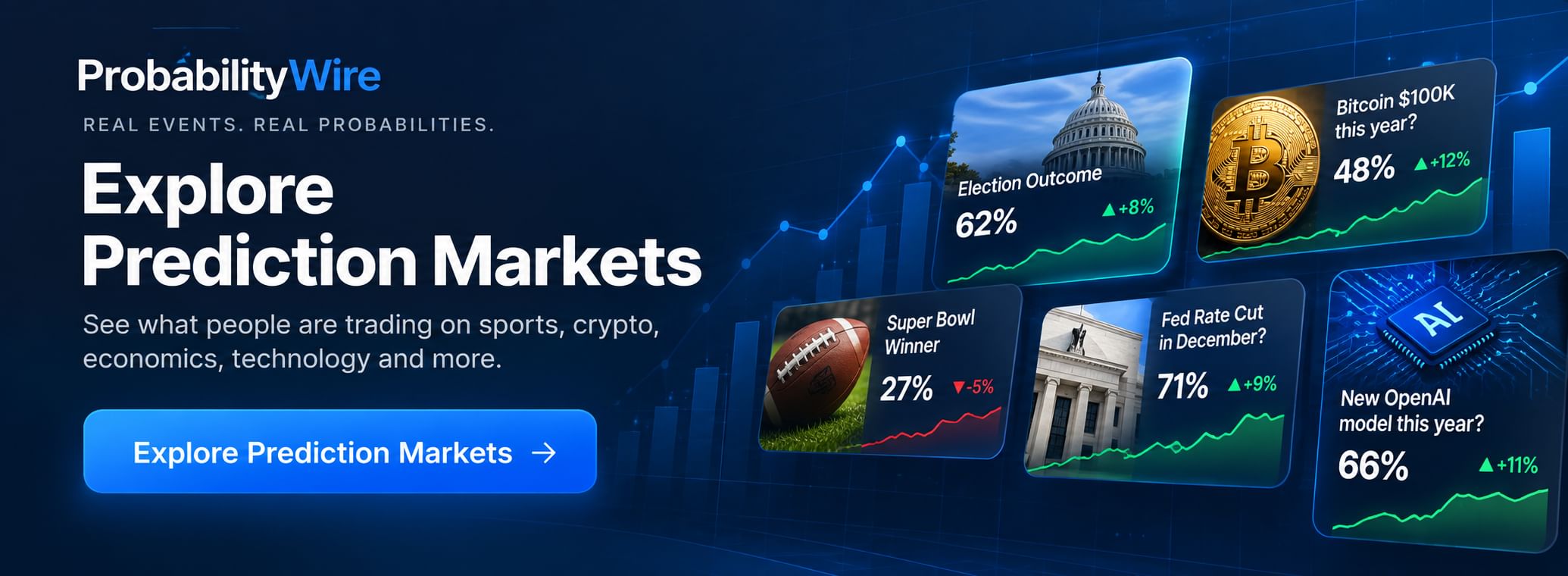
Prediction Markets, Platforms and Real-World Probabilities
ProbabilityWire covers prediction markets: platforms where people trade on the outcomes of future events. These markets turn expectations about sports, economics, cryptocurrency, technology, politics and other events into prices that can be interpreted as implied probabilities.
If a YES contract trades at around $0.65 and pays $1 if the event happens, the price represents an implied probability of roughly 65%. That does not mean the event has a 65% chance of happening with scientific certainty. It means that is where the market is currently pricing the outcome.
ProbabilityWire explains how these markets work, follows the major platforms and looks at the events attracting trading activity. The site covers Polymarket, Kalshi and other prediction-market platforms alongside the mechanics behind the numbers: event contracts, prices, liquidity, fees, order books and market resolution.
Understanding Prediction Markets
Prediction markets are built around questions with outcomes that can eventually be verified. Will Bitcoin reach a particular price? Will the Federal Reserve cut interest rates? Which team will win the Super Bowl? Will a new technology product launch before a specified date?
Participants buy and sell contracts connected to those outcomes. Prices move as traders react to new information and to each other.
That makes a prediction market more than a static forecast. An injury can change a sports market within minutes. An inflation report can alter expectations about the next Fed meeting. A company announcement can suddenly change the probability attached to a technology event.
ProbabilityWire covers both the latest numbers and the mechanics behind them, helping readers understand what a market price actually represents.
How Prediction Market Prices Work
Prediction-market prices are often easy to translate into probabilities. A YES contract priced around $0.40 can generally be read as an implied probability of approximately 40%.
The number is a market price, not a guarantee. It reflects the level at which participants are currently willing to trade. Prices can change quickly, and thinly traded markets may behave very differently from markets with substantial volume and liquidity.
Understanding concepts such as implied probability, spreads, liquidity, trading volume and order books therefore matters when interpreting the headline percentage.
Prediction Market Platforms
The industry includes dedicated prediction markets, event-contract exchanges, crypto-based platforms and established financial companies that have added event trading to their existing products.
ProbabilityWire follows major platforms including Polymarket, Kalshi, Robinhood, Crypto.com and Interactive Brokers, as well as other companies entering the sector.
Platform coverage focuses on practical differences: where a service is available, what markets it offers, how trading works, fees, deposits and withdrawals, mobile access, order types and settlement procedures.
Polymarket
Polymarket is one of the most recognizable names in prediction markets, with markets covering sports, cryptocurrency, economics, technology, politics, entertainment and other real-world events.
ProbabilityWire covers how Polymarket works, its fees, deposits and withdrawals, available markets and the mechanics of trading. It also looks at Polymarket alternatives and compares the platform directly with competitors such as Kalshi and Robinhood.
Individual Polymarket markets can also provide useful information about changing expectations. A move from 30% to 55%, for example, can tell a more interesting story than simply looking at the latest 55% figure.
Kalshi
Kalshi is another major prediction-market platform, offering event contracts across a broad range of subjects.
Coverage on ProbabilityWire looks at how Kalshi works, its fees, available markets and important differences between Kalshi and competing platforms.
Polymarket vs Kalshi is an especially useful comparison because the two platforms should not simply be treated as interchangeable. Market selection, availability, funding methods, trading structure and other features can differ.
Other Prediction Market Platforms
Prediction markets are spreading beyond specialist platforms. Brokerages, cryptocurrency companies and other financial businesses are adding event contracts and related products.
ProbabilityWire follows this wider market, including prediction products available through Robinhood, Crypto.com and Interactive Brokers. New platforms can be added to the same database and comparison structure as the industry develops.
Comparing Prediction Market Platforms
Choosing a platform involves more than checking which company has the most markets.
Availability is one of the first considerations. A platform or individual product may be available in one jurisdiction but restricted in another. In the United States, availability can also vary according to the platform, product and applicable regulatory framework.
Fees, market selection, liquidity, minimum trade sizes, payment methods, mobile access, order types and settlement rules provide additional points of comparison.
ProbabilityWire organizes these details consistently so readers can compare prediction market sites and apps without having to decipher completely different information for every brand. Comparisons include Polymarket vs Kalshi, Polymarket vs Robinhood, Kalshi vs Robinhood and alternatives to the major platforms.
Sports Prediction Markets
Sports are one of the largest areas of prediction-market activity. Contracts can cover individual games, championships, season outcomes, awards and other clearly defined events.
ProbabilityWire follows markets for major sports and competitions, including the NFL, NBA, college football and college basketball. Recurring events such as the Super Bowl and March Madness also receive dedicated coverage.
Sports prediction markets can resemble traditional sports betting at first glance, but their mechanics can be different. Contracts may change price as participants trade, and a position can sometimes be sold before the underlying event has finished.
The site explains those differences while following how probabilities change before major sporting events.
Crypto Prediction Markets
Cryptocurrency produces a constant supply of measurable questions suitable for prediction markets: whether Bitcoin will reach a certain price, whether a token will reach a new all-time high, whether a crypto-related regulatory event will occur or whether a particular milestone will be reached before a deadline.
ProbabilityWire covers crypto prediction markets with particular attention to Bitcoin and other major market-moving events.
The precise wording of crypto contracts matters. Price source, deadline and resolution criteria can determine the outcome, so the market headline alone may not tell the whole story.
Economic Prediction Markets
Economic events often have clearly defined outcomes and scheduled dates, making them a natural subject for prediction markets.
Interest-rate decisions, inflation figures and other economic indicators can all generate markets. Federal Reserve decisions are particularly useful examples because expectations can change as economic data and statements from policymakers arrive.
ProbabilityWire follows Fed rate prediction markets, inflation and CPI expectations and other major economic events while explaining exactly what each contract is measuring.
Technology and AI Prediction Markets
Technology is becoming another important source of event-driven markets. AI model releases, product launches, company announcements and other measurable milestones can all become prediction-market questions.
Expectations in this category can move particularly quickly. A product announcement, reported delay, benchmark result or company statement can materially change the market.
ProbabilityWire follows AI and broader technology prediction markets while providing context around significant changes in probability.
Prediction Markets vs Sports Betting
Prediction markets and sportsbooks can both involve uncertain future events, but they do not necessarily work in the same way.
A traditional sportsbook generally publishes odds and accepts wagers at those prices. A prediction market allows participants to trade contracts, with prices changing as buying and selling activity changes.
Another important distinction is the ability to trade out of a position. Depending on the platform and market, a participant may be able to sell a contract before the event is resolved rather than waiting for the final result.
ProbabilityWire examines the differences in pricing, trading, liquidity and settlement so the two models are not treated as if they were identical.
Prediction Markets vs Polls
Polls and prediction markets measure different things. A poll asks a selected group of people about their views, preferences or intentions. A prediction market reflects prices produced by people trading contracts on an outcome.
Neither should automatically be treated as a definitive forecast. Polls have sampling and methodological considerations, while prediction markets can be affected by liquidity, market structure, participant behavior and the information available at the time.
Looking at both can provide different perspectives on the same event.
Fees, Liquidity and Trading
An interesting probability does not necessarily mean an attractive or highly active market. Trading conditions matter too.
ProbabilityWire examines fees, liquidity, spreads, minimum trade requirements and available order types. Liquidity is especially important because an active market with many participants can behave very differently from a small market with limited trading.
The site also explains market orders, limit orders, prediction-market order books and what happens when someone wants to exit a position before resolution.
How Prediction Markets Resolve
Every prediction market eventually needs an objective answer.
A contract should specify the question being asked, the deadline, possible outcomes and the rules or information source that will be used to determine the result. Once those conditions are satisfied, the market can be resolved and settled.
Resolution criteria are worth reading carefully. Two contracts that appear to ask almost the same question may use different deadlines, definitions or sources. Those differences can determine whether a contract ultimately resolves YES or NO.
Are Prediction Markets Legal?
The legal and regulatory treatment of prediction markets depends on the platform, product and jurisdiction. Availability can therefore change over time.
ProbabilityWire tracks platform availability and regulatory information but does not assume that access in one location means a platform is available everywhere. Users should confirm current eligibility and restrictions with the relevant platform before trading.
Following Probability Changes
The latest probability is only part of the story.
Suppose a market is currently at 60%. That number becomes considerably more informative when we know it was at 32% a week ago. A large movement tells us that expectations have changed and gives us a reason to investigate what happened.
ProbabilityWire follows significant probability movements and the events surrounding them. The aim is to show what changed, when the market moved and what new information may have contributed to the shift.
Markets can move in either direction right up until resolution. A sharp move is therefore something to understand, not proof that an outcome will occur.
Explore ProbabilityWire
ProbabilityWire is built for people who want to understand what prediction markets are saying and where the numbers come from.
New readers can start with guides covering prediction-market fundamentals, implied probability, event contracts, fees and trading mechanics. Readers comparing services can explore Polymarket, Kalshi, Robinhood and other prediction-market platforms. Dedicated sections cover sports, crypto, economics, technology and other major market categories.
As prediction markets expand, ProbabilityWire will follow new platforms, new types of contracts and the events attracting the most attention.
Probabilities change. Markets move. ProbabilityWire follows the numbers behind what might happen next.